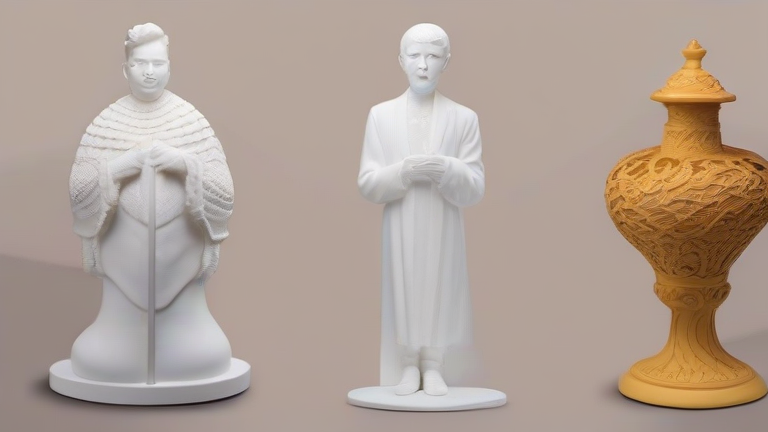
TL;DR: The porcelain figurine industry is merging heritage craftsmanship with digital precision, driven by AI-driven generative design, 3D-printed mold-making, and IoT-enabled kiln monitoring. These trends reduce production waste by up to 40% while enabling hyper-personalized, limited-edition sculptures with micron-level detail.
1. AI-Generative Design & Parametric Sculpting
Leading studios now use generative adversarial networks (GANs) to create organic, mathematically impossible forms—such as self-intersecting latticework or gradient-thickness petals—that human hands cannot sketch. Parametric modeling software (e.g., Rhino+Grasshopper) outputs 3D-printable files with 0.02mm tolerance, allowing designers to simulate firing shrinkage (typically 12–15%) before a single gram of clay is mixed. This shifts prototyping from weeks to hours, and enables “mass customization”: consumers upload a photo, and an AI algorithm morphs a standard figurine base into a personalized bust with 95% facial fidelity.
If you want to dig deeper, check out our guide on Handcrafted Porcelain Figurines: A Guide to Collectible Art .
2. Binder-Jetting 3D Printing for Complex Geometry
Traditional slip-casting fails for undercuts and hollow internal channels. Binder-jetting printers (e.g., Voxeljet’s VX4000) now deposit porcelain powder (particle size ~10µm) with a silica-based binder, producing green bodies with 0.5mm wall thickness. Post-processing involves debinding and sintering at 1,300°C in a hydrogen atmosphere, achieving 99.8% density. Key spec: layer resolution of 40µm and a build volume of 4m³, enabling single-piece sculptures up to 2 meters tall without seams. Industry impact: reduced material waste from 30% (traditional) to under 5%, and elimination of plaster mold storage.
3. IoT-Enabled Smart Kilns & Predictive Firing
New kilns from Nabertherm and KilnSitter integrate fiber-optic pyrometers and AI-controlled thermal profiling. These systems monitor 16+ temperature zones per second, adjusting heating rates to prevent crazing (micro-cracks) and pinholing. Predictive models trained on 10,000 firing cycles alert operators to thermal stress events 30 seconds before failure. For glazes, spectrally-controlled “digital glaze labs” use spectrophotometers to match Pantone colors with ΔE < 0.5, then recalculate glaze chemistry for specific clay bodies—reducing reject rates from 22% to 7% in high-end production runs.
4. Augmented Reality (AR) for Interactive Provenance
Each figurine now ships with an NFC chip or QR-linked digital twin. Using AR (Apple Vision Pro or smartphone), collectors can view the piece’s “digital genesis”: scan data, print layer history, and kiln curve. More advanced studios embed micro-etched holographic markers (readable by 0.1mm resolution scanners) that authenticate origin and ownership via blockchain. This combats counterfeiting—a market estimated at $4B annually—and adds a “smart collectible” layer for secondary-market resale.
5. Sustainable Composite Porcelain
To address mining and high CO₂ firing costs, researchers at TU Delft have developed “green porcelain” with 30% recycled ceramic waste and a novel lithium-disilicate binder. This material fires at 1,050°C (vs. 1,250°C), cutting energy use by 23%. Crucially, it maintains translucency and ring tone (tested at 4,000Hz) matching traditional Limoges. Early adopters report that the composite allows for thinner limbs (down to 1.2mm) without warping—a breakthrough for ballet dancer figurines.
FAQ
Q: Will 3D printing replace hand-sculpted porcelain figurines?
A: No—it replaces mold-making and repetitive production, but hand-finishing (e.g., hand-painting underglaze, luster application) still defines premium value. Printers handle geometry; artisans handle surface
Leave a Reply