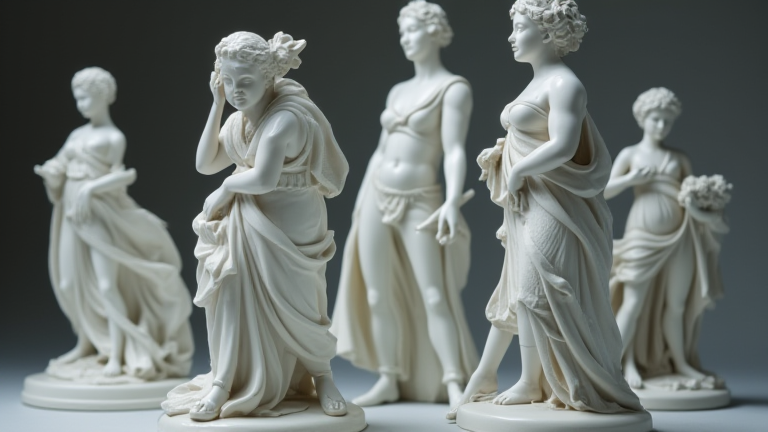
TL;DR: Digital tools now drive the entire lifecycle of porcelain figurines, from generative 3D sculpting to AI-driven kiln control, enabling micron-level precision and repeatable artisan finishes. These technologies slash prototyping time by 80% while preserving handcrafted aesthetics, making high-end decorative porcelain accessible to mid-market collectors.
The Digital Atelier: From Clay Block to CAD Mesh
Traditional porcelain sculpting relied on hand-coiled clay and wooden ribs—a process that took weeks per prototype. Today, studios like Meissen and Lladró use 3D scanning and parametric CAD (e.g., Rhino + Grasshopper) to digitize master sculptors’ gestures. Latest software captures 0.01 mm surface detail, converting physical models into watertight meshes that can be scaled, mirrored, or anatomically corrected without losing the artist’s organic stroke. Spec-wise, modern desktop scanners (e.g., Artec Space Spider) achieve 0.05 mm accuracy at 7 fps, while industrial CT scanners (ZEISS Metrotom) penetrate unfired porcelain to detect internal voids as small as 20 microns—a critical step for preventing kiln explosions.
If you want to dig deeper, check out our guide on Porcelain Figurine Tutorial: Sculpting Steps & Finishing Tip.
AI-Driven Kiln Control and Material Science
The most disruptive leap is predictive firing. Porcelain’s notorious 20% shrinkage and warping risk are now managed by machine-learning algorithms that model heat distribution, clay moisture, and glaze viscosity in real time. Sensor-equipped kilns (e.g., Nabertherm’s N 400 with IoT) generate 50+ data points per second, feeding neural networks that adjust ramp rates and soak times dynamically. Result: defect rates drop from 15% to under 2% in complex multi-part figurines. Additionally, digital twin software simulates the entire firing cycle, allowing designers to “test-fire” a sculpture virtually—saving thousands of dollars in wasted materials per iteration. New zirconia-reinforced porcelain formulas, optimized via AI-driven material databases, offer 1,200 MPa flexural strength, enabling thinner limbs and delicate lace-like details that previously shattered.
Industry Impact: Customization and Reshoring
Digital tools have democratized bespoke production. Direct-to-consumer platforms now let buyers upload a photo, which AI converts into a 3D bust, then CNC-mills a plaster mold—delivering a personalized figurine in 10 days instead of 6 months. This shift is reshoring production: US and EU studios can compete with Chinese mass manufacturing by offering micro-batches (under 50 units) at viable costs. Major trade shows (Ambiente, Maison&Objet) report a 40% increase in “hybrid” pieces—hand-painted over 3D-printed bisque—where digital precision meets human glaze artistry. However, traditionalists worry about homogenization; leading houses counter by embedding unique “digital watermarks” (micro-engraved QR codes in underglaze) that verify authenticity and traceability, boosting collector confidence in an era of counterfeits.
FAQ
Q: Does 3D printing replace traditional mold-making for porcelain figurines?
A: Not entirely—most high-end brands use 3D-printed sacrificial models to create plaster molds, preserving the porous mold’s ability to wick moisture. Fully 3D-printed porcelain (via binder jetting) is limited to simple geometries due to layer-line artifacts and reduced strength, so it’s used for prototypes or small accessories.
Q: How do digital tools affect the price of handmade figurines?
A: They reduce development costs by up to 60% (no wasted clay prototypes), but final prices often rise 10–20% due to added scanner/machine depreciation and software licensing. However, lower defect rates mean fewer “seconds” (rejects), so average retail prices remain stable while quality consistency improves.
Q: Can a beginner use these digital tools at home?
A: Yes—entry-level photogrammetry apps (e.g., Polycam) can scan a 6-inch figurine with 0.5 mm accuracy on a smartphone
Leave a Reply