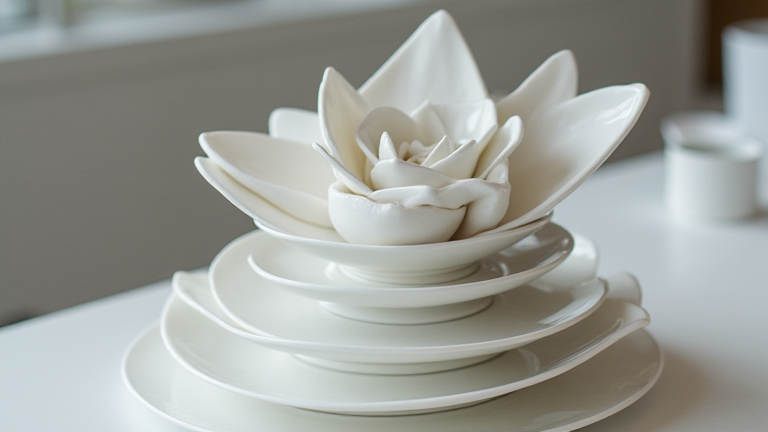
Crafting the Future: How Tech is Revolutionizing Porcelain Art
TL;DR: Advanced 3D printing and AI-assisted design are transforming porcelain figurines by enabling hyper-realistic details and mass customization that traditional hand-molding cannot achieve. This technological integration is shifting the industry from artisanal scarcity to scalable precision, allowing for complex structural integrity in delicate sculptures.
The world of porcelain art is undergoing a silent but profound transformation. For centuries, the creation of intricate figurines and sculptures relied entirely on the steady hands of master potters and the limitations of traditional plaster molds. Today, digital fabrication technologies are breaking these boundaries. By integrating high-resolution 3D scanning with additive manufacturing, artists and manufacturers are producing porcelain pieces with geometric complexities that were previously impossible to cast. This shift is not replacing the human touch but rather augmenting it, allowing creators to focus on aesthetic vision while technology handles structural precision.
If you want to dig deeper, check out our guide on Porcelain Figurines & Sculptures: Timeless Collectibles.
Precision in Digital Modeling
The first major leap in this revolution is the digitization of design. Artists now use CAD software to model figurines with micrometer-level precision. Unlike traditional sculpting, where errors are costly and difficult to correct, digital models can be iterated infinitely. Recent developments include the use of neural networks to generate unique pattern variations for surface textures, ensuring that no two porcelain sculptures look exactly alike despite being produced from the same base model. This capability is particularly impactful for high-end collectibles, where uniqueness and intricate detailing are key value drivers. The digital files serve as the definitive master, ensuring consistency across production runs while allowing for bespoke modifications for individual clients.
Additive Manufacturing and Material Specs
The core of this technological shift lies in specialized 3D printing techniques tailored for ceramic materials. Standard FDM 3D printing is unsuitable for porcelain due to heat sensitivity and material viscosity. Instead, the industry is adopting Binder Jetting and Direct Ink Writing (DIW). These processes use a fine slurry of porcelain powder mixed with organic binders. The key specification here is particle size; modern printers utilize porcelain powders with a particle diameter of less than 10 microns. This fine granularity ensures that the printed green body has a smooth surface finish, reducing the need for extensive sanding before firing. Furthermore, the layer thickness of these advanced printers has dropped to 50 microns, allowing for the reproduction of delicate features like thin wings on bird figurines or intricate lace-like patterns on vase sculptures. The resulting pre-fired objects, known as greenware, are then subjected to a debinding process in a controlled atmosphere furnace before the final high-temperature firing at 1,400°C, which vitrifies the porcelain to achieve its characteristic translucency and strength.
Industry Impact and Sustainability
The impact on the porcelain industry is multifaceted. Economically, it reduces the cost of tooling and mold-making, which previously accounted for a significant portion of production costs for small-batch items. This lowers the barrier to entry for new designers and allows established brands to test new product lines with minimal risk. From a sustainability perspective, additive manufacturing minimizes material waste. Traditional slip casting often results in significant scrap from trimming and failed casts. In contrast, 3D printing uses material only where needed, and any excess slurry can often be recycled. Additionally, the ability to print complex, lightweight lattice structures inside sculptures reduces the overall weight of the final product, leading to lower shipping emissions and easier handling for consumers. This efficiency is driving a new market segment of affordable, high-quality artistic porcelain, making sophisticated home decor accessible to a broader audience.
FAQ
Q: Can 3D printed porcelain achieve the same level of translucency as hand-thrown pieces?
A: Yes, provided the porcelain slurry is properly formulated and the firing schedule is optimized. The density of the printed structure can be matched to traditional casting, allowing light to pass through thin sections just like traditional porcelain.
Q: What is the maximum size for a single porcelain figurine printed this way?
A: Current industrial-grade ceramic 3D printers can produce single pieces up to
Leave a Reply