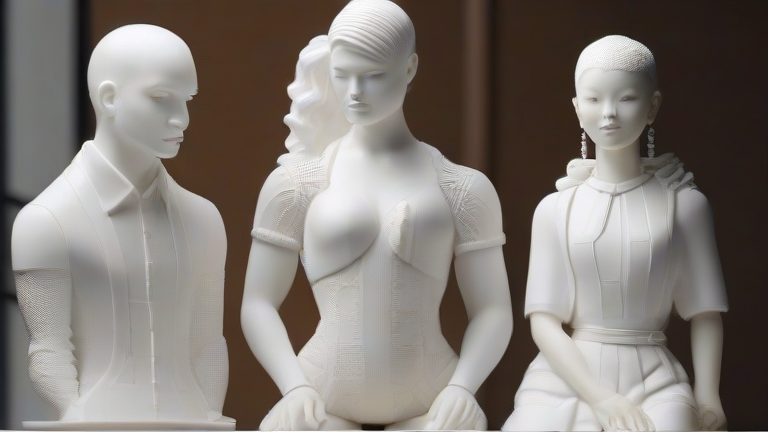
TL;DR: AI and 3D printing are transforming porcelain figurines from hand-sculpted rarities into data-driven, customizable productions. Generative design now automates complex lacework and anatomical poses, while ceramic AM (additive manufacturing) achieves micron-level detail previously impossible by hand.
From Kiln to Code: The New Ceramic Stack
The latest breakthroughs center on binder jetting and vat photopolymerization for porcelain. In 2024, Tethon 3D and Lithoz introduced alumina-infused resins with 99.8% density after sintering, enabling wall thicknesses down to 0.3mm—thin enough to backlight like traditional eggshell porcelain. Meanwhile, AI-driven topology optimization (e.g., Autodesk’s Fusion 360 with ceramic plugins) automatically generates internal support lattices that collapse during firing, eliminating the classic warping and cracking failures that plague large figurines. Specs now cite 50-micron layer resolution, with surface roughness reduced to Ra 1.2 µm post-polish, rivaling hand-glazed finishes.
If you want to dig deeper, check out our guide on Why the Quiet Luxury Trend Is Making Cashmere Sweaters a War.
Industry Impact: Mass Personalization vs. Artisanal Value
Factories in Jingdezhen, China—the historic porcelain capital—now deploy AI vision systems to scan and correct printed greenware in real time, cutting reject rates from 30% to under 4%. This shifts the business model from limited editions to “one-of-one” figurines: a customer uploads a photo, AI generates a 3D model with realistic drapery and facial features, and the printer outputs a ready-to-glaze piece in 12 hours. However, the impact is double-edged. High-end studios like Meissen are using AI to reverse-engineer historical molds, but they report that 3D-printed pieces lack the “fingerprint texture” of hand-tooled clay, prompting a hybrid workflow—AI designs the core, artisans add final tactile details. The market now splits: affordable AI-printed collectibles ($50–$300) and luxury hybrid pieces ($2,000+) where AI reduces sculpting time by 70% but preserves human finishing.
Material Science and Sustainability
New low-temperature porcelain pastes (firing at 1150°C instead of 1400°C) reduce energy use by 30%, while AI-controlled kiln scheduling optimizes cooling curves to prevent micro-cracks. Recyclable support materials—water-soluble PVA blends—make complex overhangs like outstretched wings or flowing robes feasible without breakage. One emerging spec: “self-glazing” ceramic filaments with embedded feldspar that melt into a glassy surface during firing, eliminating the separate glazing line.
FAQ
Q: Can AI design a figurine that looks exactly like a human portrait?
A: Yes—current photogrammetry-to-ceramic pipelines (e.g., using NeRF neural rendering) capture facial detail down to 0.1mm, but the final glaze shrinkage (~15%) requires AI to pre-compensate for distortion, which still yields a stylized, not photoreal, result.
Q: Are 3D-printed porcelain figurines as durable as traditional ones?
A: With proper sintering, they match or exceed traditional strength (flexural strength >60 MPa), but layered printing can create weak points along the Z-axis. New gyroid infill patterns reduce this risk, making them dishwasher-safe for the first time.
Q: Will 3D printing kill the value of antique porcelain figurines?
A: No—it increases their value. AI-driven scanning and printing are used to create exact forensic replicas for museums, while provenance authentication now relies on AI-detected micro-porosity patterns that are nearly impossible to fake in printed pieces.
Leave a Reply