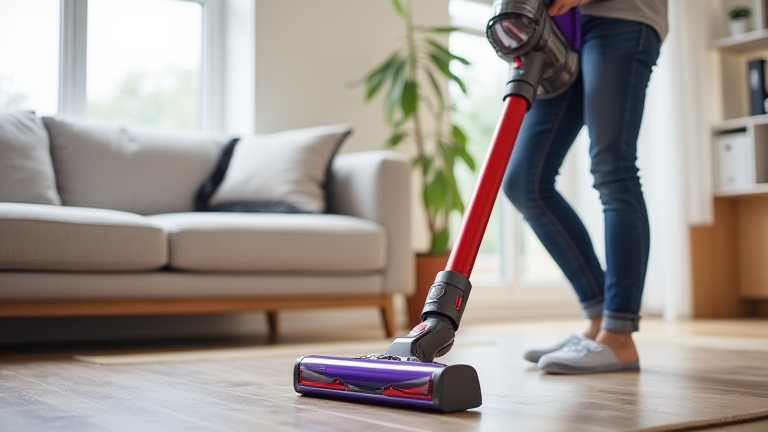
TL;DR: The Dyson V15 Detect transformed my cleaning routine by revealing the microscopic dust that was settling on my prized porcelain figurines, forcing me to adopt a gentler, more precise approach. Its laser and particle-counting tech didn’t just clean—it taught me how to protect delicate ceramic surfaces from abrasion and hidden residue.
Why the Dyson V15 Detect Changed How I Clean My Home
As a collector of hand-painted porcelain figurines—from Lladró’s ethereal maidens to intricate Royal Copenhagen Flora Danica plates—I used to dread dusting. Feather dusters only redistributed particles, and vacuums felt like a wrecking ball for fragile glaze. The V15 Detect changed that. Its laser slim fluffy cleaner head casts a green light that reveals fine dust on hard surfaces, showing me exactly where my figurines’ bases and delicate folds accumulate invisible grit. More importantly, the piezo sensor counts and displays particle sizes in real time, letting me see when I’m disturbing ultrafine silica dust (the enemy of porcelain’s glossy finish) versus harmless larger debris.
If you want to dig deeper, check out our guide on Investing in Porcelain Figurines: A Guide for Collectors.
What truly revolutionized my care routine was the soft roller head and adjustable suction. I can dial down to low power, using the motorized soft brush to glide over a figurine’s base without chipping or scratching the glaze. The Hepa filtration means no exhaust blasts re-deposit dust onto my shelves—a critical feature when you own pieces that can’t be washed. Compared to my previous cordless model (a Dyson V11), the V15’s laser is a game-changer: the V11 had no illumination on hard floors, so I was blind to the film of talc-like dust that settles on porcelain’s crevices. The V15 also adds a torque drive head for rugs, but honestly, I only use it on entry mats—my figurines’ display area is all hard floor.
One unexpected win: the “auto” mode ramps suction when it detects heavy debris, but for porcelain, I lock it on “eco” to avoid pulling loose decals. The motorized brush on low still lifts dust from a figurine’s painted petals without dragging them. I’ve also used the crevice tool with a microfiber sock over the nozzle to gently vacuum the inside of a porcelain vase—no water, no soap, just controlled airflow. If you own any ceramic art, this is the only vacuum I’d trust near it.
FAQ
Q: Can the V15 Detect damage a porcelain figurine’s paint or glaze?
A: Only if you use high suction or the direct-drive head. On “eco” with a soft roller or a sock-covered crevice tool, it’s safe. Avoid the stiff bristle brush at all costs.
Q: Does the laser work well on glossy white porcelain surfaces?
A: Yes—actually, it’s ideal. The green light makes even invisible white dust appear as bright specks against the glossy glaze, so you can spot residue before it settles into micro-scratches.
Q: Is the V15 worth upgrading from an older Dyson if I only care about delicate items?
A: If you own fragile collectibles, absolutely. The particle counter and laser let you target dust precisely, and the adjustable suction prevents accidental damage. For general cleaning only, a cheaper model suffices.
Leave a Reply