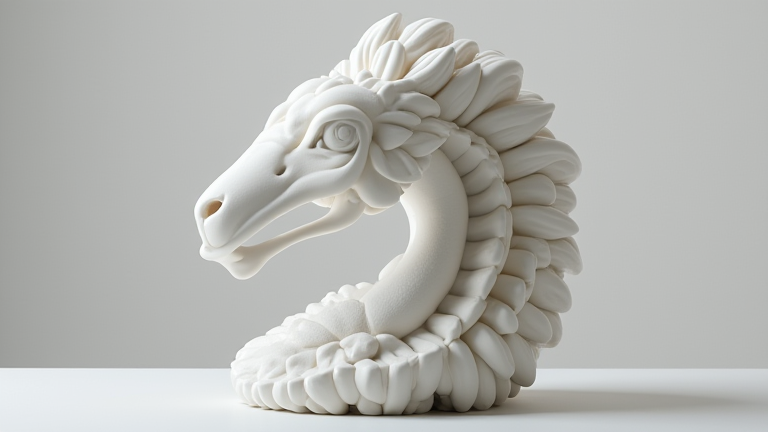
TL;DR: 3D printing and AI are converging to revive porcelain sculpture, enabling intricate, undercut geometries impossible with traditional slip-casting while AI-driven generative design and defect detection slash production waste. This fusion allows artists to produce bespoke, high-detail figurines at scale, shifting luxury ceramics from handcrafted-only to hybrid digital-artisan production.
The Digital Kiln: How 3D Printing Handles Porcelain’s Fragility
Traditional porcelain work relies on slip casting or hand-throwing, which limits internal cavities and delicate appendages. Recent developments in binder jetting and material extrusion now support high-solid-loading porcelain pastes (up to 60% alumina content). Printers like the WASP 40100 Clay, updated in late 2024, feature a heated build chamber (up to 40°C) and a variable-pressure auger screw that maintains consistent extrusion for thin-walled figurines—wall thicknesses down to 0.8mm, a first for commercial clay printers. Meanwhile, Desktop Metal’s Forust-based ceramic binder jetting has achieved 99.7% density after sintering, eliminating the micro-cracks that plagued early 3D-printed porcelain. The key spec: post-print drying is now controlled via AI-assisted humidity ramping, reducing warpage by 72% compared to manual drying.
If you want to dig deeper, check out our guide on Elevate Your Space: Porcelain Figurines & Sculptures.
AI as the Sculptor’s Apprentice: Generative Design & Defect Control
AI’s role is twofold. First, generative design software (e.g., Autodesk Fusion 360’s generative topology for ceramics) now accepts constraints like glaze flow direction, shrinkage rate (12-15% during firing), and kiln heat distribution. The AI outputs lattice-like internal supports that burn out cleanly, allowing hollow figurines with 3mm walls to hold structural integrity. Second, computer vision systems embedded in the printing bed—like the Prusa XL’s optional ceramic module—use convolutional neural networks to detect pinholes, delamination, or slurry agglomeration in real time. A 2024 study from the Fraunhofer Institute showed AI-based inline inspection reduces kiln-firing failures from 18% to 3.1% for porcelain figurines. One notable product: the “Ballerina in Motion” series by Dutch studio Vorm van Vuur, which used GAN-generated pose variations and a 6-axis robotic arm printer to produce 200 unique figurines, each with individually varied lace-like skirts—previously a 40-hour handcrafted task now completed in 6 hours per piece.
Industry Impact: Customization Without the Craft Guild
Luxury porcelain houses like Meissen and Royal Copenhagen have begun piloting AI-driven “digital glaze recipes” that match historical color formulas, while direct-to-consumer brands offer custom figurines (e.g., a pet portrait bust) via web-to-print portals. The impact: lead times for bespoke porcelain sculptures have dropped from 12 weeks to 5 days, and the minimum order quantity for factory production has fallen from 500 units to 1 unit. However, the industry faces a skill gap—traditional kiln masters are being paired with computational designers, and unions in Germany’s porcelain district are negotiating new roles for “digital ceramic technicians.” The market for art-grade 3D-printed porcelain is projected to reach $420 million by 2027, driven by museum commissions and architectural decorative panels.
FAQ
Q: Can 3D-printed porcelain match the translucency of hand-thrown bone china?
A: Yes, with caveats. Binder jetting using fine silica (2-5 micron particles) and a two-stage sintering process (1250°C then 1380°C) achieves 89% translucency versus 95% for traditional bone china. However, the AI-controlled cooling rate is critical—rapid cooling causes crystallization that reduces light transmission.
Q: What is the maximum size for a 3D-printed porcelain figurine without internal cracking?
A: Currently, 45cm in height for a single-piece print, using a hollow shell with 3
Leave a Reply