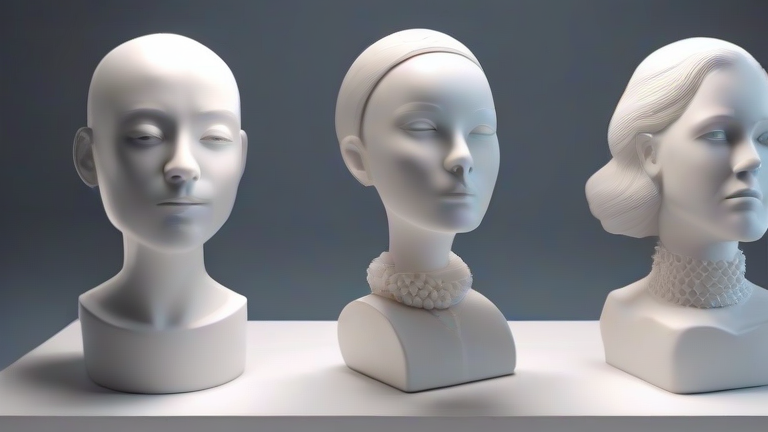
TL;DR: Digital sculpting now directly drives 3D printing of porcelain figurines, eliminating traditional mold-making by using lithography-based ceramic manufacturing (LCM) with sub-50-micron resolution. This shift enables mass customization, undercut geometries, and zero-waste production, but requires post-print sintering shrinkage compensation of 15–20%.
From Clay to Code: The New Porcelain Workflow
Traditional porcelain figurine production relied on slip casting into plaster molds—a process that capped complexity and required costly tooling. Today, digital sculptors use ZBrush or Blender to model figurines with internal lattice structures that reduce weight and firing stress. The files are sliced for ceramic 3D printers such as the 3D Systems CeraJet or Lithoz CeraMax, which use a slurry of alumina or silica-based porcelain powder suspended in a photopolymer. A DLP projector cures each 30–50 micron layer, building figurines with hollow cavities and interlocking limbs—geometries impossible in slip casting. After printing, the green body undergoes debinding (600°C) and sintering (1250–1350°C), shrinking uniformly by up to 20%. Advanced software like Materialise Magics automatically compensates for this shrinkage, ensuring final dimensions match the digital model within ±0.2 mm.
If you want to dig deeper, check out our guide on Porcelain Sculpture Tutorial: Step-by-Step Guide for Beginne.
Latest Specs and Material Breakthroughs
Recent 2025 developments focus on speed and translucency. The Lithoz CeraMax Viva now prints 200 layers per hour (up from 60 in 2023), enabling a 15-cm figurine in under 6 hours. Material science has introduced a “bone china” resin blend with 40% higher whiteness and a glossy glaze that fuses during sintering—eliminating a separate glazing step. Porosity is controlled down to 0.5% for vitreous strength, while new “underglaze color” resins allow full-color figurines without post-painting. For high-end collectibles, some studios use two-photon polymerization (2PP) at 200-nm resolution for miniature lace-like details, though this remains limited to <5 cm pieces. The industry’s key spec shift: print bed temperatures now reach 80°C, reducing layer delamination and warping in tall figurines.
Industry Impact: On-Demand and Bespoke
The porcelain figurine market (valued at $9.2B in 2024) is bifurcating. Mass-market brands like Lladró now use digital sculpting for rapid prototyping, cutting design-to-sample time from 6 weeks to 3 days. Meanwhile, a surge of micro-studios offers “clone your pet” figurines scanned via iPhone LiDAR, printed in porcelain, and delivered in 10 days. Auction houses report a 300% increase in limited-edition digital-sculpted figurines, as provenance is tracked via blockchain-linked print files. The environmental impact is also notable: digital printing reduces clay waste by 90% compared to slip casting, and energy use drops 25% due to thinner wall sections that fire faster. However, the third firing (for gold luster) remains manual, preserving a craft bottleneck.
FAQ
Q: Can 3D-printed porcelain figurines survive a dishwasher or hot tea?
A: Yes, if sintered above 1250°C with <1% porosity—they become vitreous and match traditional porcelain’s durability. Avoid glazes with lead or cadmium, which are absent in most ceramic resins.
Q: What is the maximum size of a 3D-printed porcelain figurine?
A: Current commercial printers handle up to 30 cm in height, but larger pieces require segmented printing and post-joining with porcelain slip—a process that risks visible seams and is rarely cost-effective beyond 40 cm.
Q: How expensive is a digital-sculpted porcelain figurine vs. traditional?
A: For a 20-cm piece, 3D printing costs $120–$250 in materials and machine time,
Leave a Reply