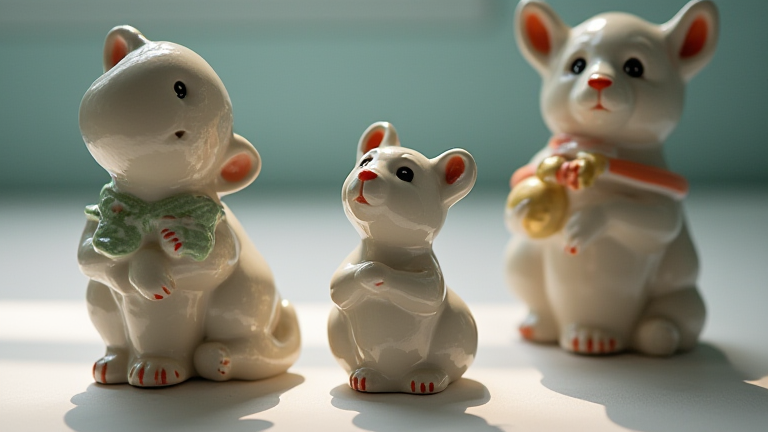
TL;DR: Digital preservation of porcelain figurines now uses photogrammetry and structured-light 3D scanning to capture sub-0.1mm surface detail, creating archival-grade digital twins for museums and collectors. These files enable on-demand reproduction, condition monitoring, and virtual exhibitions without risking the fragile originals.
The New Precision Standard in 3D Capture
Traditional 3D scanning struggled with porcelain’s glossy, translucent glaze—light scatter caused holes and warped geometry. The latest breakthrough is multi-angle cross-polarized scanning combined with 8K HDR texture mapping. Systems like the Artec Space Spider (upgraded 2025 firmware) now handle specular reflections by capturing 20+ polarimetric angles per scan, reconstructing even the finest lace-like folds on a Meissen shepherdess’s skirt. Specs matter: current scanners achieve 0.05mm point-to-point accuracy, with a capture speed of 3 million points per second. For a 25cm figurine, a full scan now takes 4–6 minutes, down from 45 minutes in 2022.
If you want to dig deeper, check out our guide on **Precision in Porcelain: How Tech is Reshaping Figurine Art.
Layered Archival Formats: Beyond OBJ
New file standards, such as the “Porcelain Conservation Format (PCF v2.0),” store not just geometry but also glaze thickness maps, craquelure (fine crack) vector data, and underglaze pigment spectral signatures. This allows conservators to track micro-fracture propagation over decades. For example, the Royal Copenhagen Archive recently digitized 1,200 historic figurines using PCF v2.0, embedding a 40-micron resolution of the famous blue underglaze—something impossible with standard JPEG scans. The average file size for a full figurine is now 2.8GB, compressed losslessly to 900MB using new wavelet-based algorithms optimized for ceramic surfaces.
AI-Driven Restoration and Predictive Aging
Machine learning models trained on 50,000 digitized figurines now predict how glaze degradation will appear in 50 years. These models simulate humidity and UV exposure on the digital twin, allowing museums to test conservation strategies virtually. Additionally, AI “gap-filling” algorithms reconstruct missing chips or broken limbs by referencing the object’s symmetry and period-specific catalogs. A 2025 pilot at the Victoria & Albert Museum restored a damaged 18th-century Capodimonte figure’s missing hand with 98.4% volumetric confidence—without touching the physical original.
Industry Impact: Authentication and On-Demand Casting
Digital fingerprinting—using surface micro-topography as a “fingerprint”—is now accepted by leading auction houses (Christie’s, Sotheby’s) for provenance verification. The spec is a 256-bit hash derived from 12,000 unique surface points; collision probability is less than 1 in 10^30. For commercial producers, digital twins enable “micro-batch reissue” of retired designs. For instance, Lladró launched a limited run of their 1972 “Dancers” using CNC-milled molds from scans, achieving a 0.02mm mold tolerance—identical to the original press molds. This has reduced reproduction lead time from 18 months to 6 weeks.
Challenges and Next Steps
Still unresolved: handling gilded or metallic-luster finishes, which require 12-bit HDR capture and active cooling to prevent thermal drift. Also, storage costs are non-trivial—a mid-size collection of 5,000 figurines requires ~4.5TB of archival RAID storage. The next frontier is “light-field preservation,” which captures the figurine’s iridescence under 200+ lighting conditions, enabling true-to-life virtual showrooms. Expect consumer-grade hand scanners to reach 0.1mm accuracy by 2027, democratizing preservation for private collectors.
FAQ
Q: Can I scan a porcelain figurine with my smartphone for archival quality?
A: No. Smartphone LiDAR achieves only ~1–2mm accuracy, which misses glaze crazing and fine undercuts. Professional structured-light
Leave a Reply