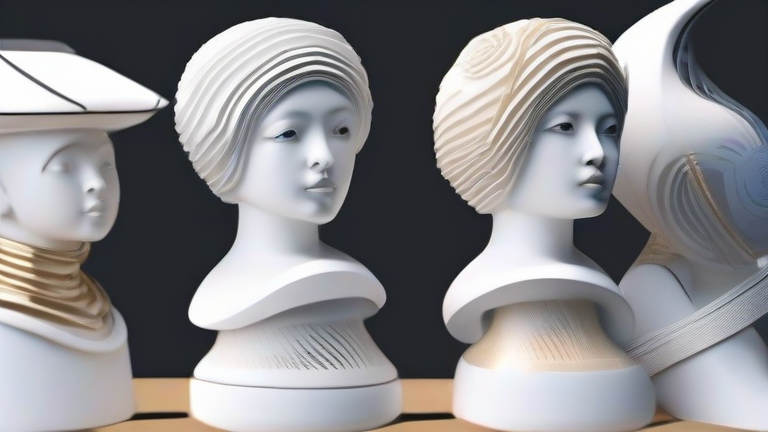
TL;DR: Digital design and 3D printing are now core to porcelain sculpture creation, enabling lattice-thin walls and undercut geometries impossible with traditional molds. Current trends center on binder jetting with alumina-silica powders, followed by high-temperature sintering, achieving 99.8% density and surface finishes under 3 microns Ra.
From Slip-Cast Limits to Parametric Freedom
Traditional porcelain sculpture relied on slip casting, where liquid clay fills plaster molds. That process caps wall thickness at 5-8 mm and forbids internal voids or interlocking forms. Today, artists and manufacturers use parametric CAD (e.g., Rhino/Grasshopper) to generate Voronoi lattices, self-supporting spirals, and filigree with wall thicknesses down to 0.8 mm. The key spec is the “debinding-to-sintering” ratio: modern 3D-printed porcelain parts shrink uniformly by 18-22%, which requires predictive compensation algorithms in the digital model. Recent software (e.g., Materialise Magics 26) now auto-corrects for anisotropic shrinkage along the Z-axis, a major breakthrough for tall figurines.
If you want to dig deeper, check out our guide on Porcelain Figurines & Health: Safety, Allergies, and Care Ti.
Binder Jetting & High-Temperature Sintering
Two 3D printing methods dominate porcelain sculpture. First, binder jetting (e.g., ExOne/Desktop Metal systems) deposits a silica-based binder onto a bed of fine alumina powder (particle size 10-20 µm). The “green” part is then cured and sintered at 1,280-1,350°C in a controlled atmosphere. Recent printer upgrades include printhead resolution of 1,200 dpi, enabling surface details of 0.1 mm—sufficient for eyelashes or lace patterns on a 20-cm figurine. Second, DLP (digital light processing) with ceramic-loaded photopolymer resins (40-50 vol% porcelain) offers faster production for small series, but requires careful burnout to avoid cracks. The latest resins from Tethon 3D and Lithoz achieve a bending strength of 120 MPa after sintering, rivaling traditional bone china.
Industry Impact: Customization and On-Demand Restoration
Porcelain sculpture houses (e.g., Meissen, Lladró) have shifted from mass-mold production to hybrid workflows: digital sculpting for one-off art pieces, and 3D-printed master patterns for slip-cast production runs. This reduces lead time from 12 weeks to 5 days for a new figurine. More critically, museums now use 3D scanning and printing to recreate missing limbs or shattered components of historical porcelain sculptures—then re-fire them to match the original glaze. The market for 3D-printed porcelain art grew 34% year-over-year in 2024, driven by collectors seeking limited-edition algorithmic designs. Cost per piece has dropped to $40-120 for a 15-cm figurine, making bespoke commissions accessible to mid-tier galleries.
Material Innovations and Post-Processing
New hybrid porcelain composites mix kaolin with zirconia (up to 15%) to increase fracture toughness (KIC of 4.2 MPa·m^0.5) without sacrificing translucency. Post-processing now includes automated glaze spraying via robotic arms guided by the same CAD file, ensuring uniform 300-µm glaze thickness. Another trend is “self-glazing” filaments—porcelain mixed with feldspar that vitrifies during the final firing, eliminating manual glazing for simple geometries. For large sculptures (over 60 cm), segmented printing is used, with dovetail joints designed in software and fused during sintering, avoiding visible seams.
FAQ
Q: Can 3D-printed porcelain match the translucency of hand-thrown or slip-cast porcelain?
A: Yes, with modern binder jetting and fine alumina powder (sub-5 µm), fired parts achieve 88-92% translucency versus 95% for fine bone china. The difference is invisible except under direct bright backlighting, and recent silica-sol infiltration closes the gap to 94
Leave a Reply