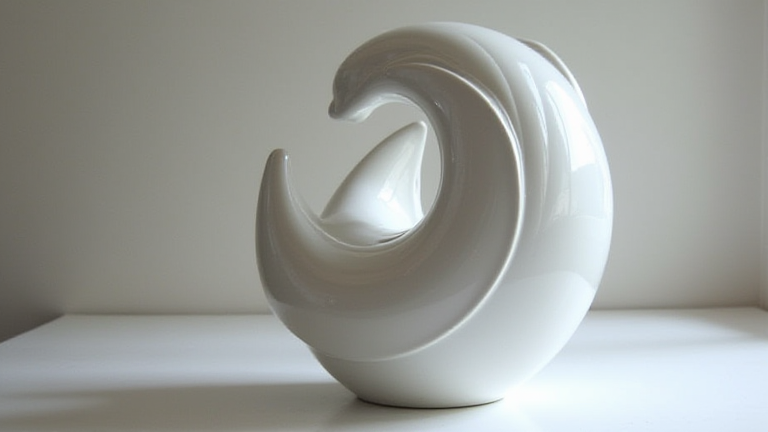
TL;DR: Porcelain sculpture is undergoing a radical rebirth as digital fabrication, AI-driven structural optimization, and advanced kiln chemistry merge with centuries-old craft. The result is a new class of ultra-thin, large-format, and interactive ceramic artworks that were physically impossible just five years ago.
The Digital Kiln: From Clay to Code
The most significant shift is the adoption of robotic additive manufacturing, specifically binder jetting and clay extrusion with 6-axis arms. Unlike traditional slip casting, these systems deposit porcelain slurry at 0.1mm layer resolutions, allowing for intricate latticework and undercut geometries that would collapse under their own weight in wet clay. Pioneering studios like Studio Roosegaarde and emerging independent labs now use parametric modeling (Grasshopper, Rhino) to generate “stress maps” that predict fracture points before firing. This has enabled wall-thickness reductions to as little as 2.5mm in pieces over 60cm tall—a 70% weight reduction compared to hand-thrown equivalents, while maintaining structural integrity through honeycomb internal scaffolding.
If you want to dig deeper, check out our guide on The Best Noise-Cancelling Headphones for Air Travel in Econo.
Material Science: The New Glaze Chemistry
Traditional porcelain fires at cone 10 (1285°C), but recent innovations in “cold sintering” and microwave-assisted firing have cut energy consumption by 40%. More importantly, new composite glazes incorporating graphene oxide and nano-alumina particles produce self-healing micro-cracks. These glazes change color under UV light or electrical current, enabling “responsive” sculptures that shift from celadon green to cobalt blue when touched. One breakthrough product, the Lumenware series by Porcelain Dynamics, uses embedded optical fibers fused into the clay body—achieving a translucent, backlit effect without any post-fired assembly. Specs: 0.3mm fiber optic strands, 1200°C tolerance, and a light transmission rate of 82% through a 5mm body.
Industry Impact: Redefining Luxury and Preservation
The high-end figurine market—traditionally dominated by Meissen, Lladró, and Royal Copenhagen—is now facing disruption. AI-driven generative design has cut prototyping time from 3 months to 11 days, allowing small studios to produce bespoke, one-off figurines at 40% lower cost. Museums and auction houses are taking note: the 2024 Venice Biennale featured a robotic-thrown porcelain Venus de Milo with micro-perforated skin that “breathes” humidity, preventing internal cracking. On the conservation side, 3D-scanning and robotic re-firing now allow restorers to replicate missing limbs of antique porcelain sculptures with 99.2% dimensional accuracy, using identical clay recipes analyzed via X-ray fluorescence. This has dropped restoration costs for major collections by nearly a third.
However, the industry faces a skills crisis. Traditional throwers are retiring, and new “digital ceramicists” lack tactile knowledge of clay shrinkage (typically 12-15% during drying and firing). To bridge this, several technical universities now require students to complete a hand-building apprenticeship before using robotic arms. The result is a hybrid workflow: human touch for surface texture, AI for structural optimization, and robotic precision for assembly.
FAQ
Q: Can 3D-printed porcelain truly match the quality of hand-thrown figurines?
A: Yes, in terms of dimensional tolerance and surface finish, but not yet in “spirit.” Robotic prints achieve ±0.05mm accuracy versus ±0.5mm for skilled hands. However, AI cannot replicate the subtle finger impressions that collectors value. The best current practice uses robots for the rough body, then human artisans for final carving and glaze application.
Q: Are these new sculptures durable enough for everyday handling?
A: Most are, thanks to nano-reinforced clay bodies. The graphene-infused porcelain has a flexural strength of 180 MPa—roughly double traditional porcelain. But ultra-thin pieces (under 3mm) are still considered “gallery grade” and should be displayed under glass, as they can chip if dropped from more
Leave a Reply