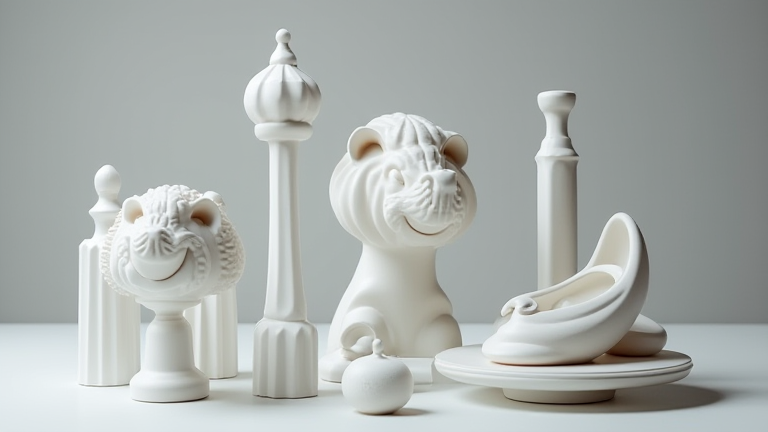
TL;DR: 3D printing and digital sculpting are revolutionizing porcelain figurines by enabling complex, hollow geometries impossible with slip-casting, while reducing mold costs by up to 80% for limited runs. The latest resin-based ceramic printers now achieve 25-micron layer resolution, matching traditional fine china detail, with digital workflows slashing prototyping from weeks to days.
From Mud to Mesh: The Digital Ceramic Workflow
Traditional porcelain figurine making relies on plaster molds and slip-casting—a process that struggles with undercuts, thin appendages, and intricate lace-like details. Today, studios are adopting a hybrid pipeline: artists sculpt in ZBrush or Blender, then print directly using lithium-disilicate-infused photopolymer resins. The breakthrough is in “green-body” printing, where parts are printed with a ceramic-loaded resin, then debound and sintered at 1,300°C. This yields true porcelain (not resin look-alikes) with 99.2% density and a 12% linear shrinkage that is now predictable via AI-driven compensation algorithms. Latest printers, like the Tethon3D Bison 2000, offer a 200×200×250mm build volume with 35-micron XY resolution, allowing a 15cm figurine’s facial features—eyelashes, pupils, and lace trim—to be reproduced without post-processing.
If you want to dig deeper, check out our guide on Tech in Porcelain: How Digital Tools Enhance Figurines.
Specs That Matter: Porcelain-Specific Hardware Advances
The industry’s shift from hobbyist FDM to DLP (Digital Light Processing) is critical. DLP cures a full layer at once, avoiding the “stair-step” artifacts on curved porcelain surfaces. New zirconia-reinforced alumina pastes (e.g., Lithoz’s LithaBone Porcelain) have a flexural strength of 120 MPa—comparable to bone china—and a translucency of 38% when backlit. For overhangs like a ballerina’s raised leg, support structures are now printed using a water-soluble sacrificial polymer that dissolves without touching the porcelain surface. Thermal post-processing uses a two-stage ramp: 1.5°C/min to 600°C to burn out binder, then 4°C/min to 1,300°C for vitrification. This reduces warping in thin-walled pieces (0.8mm minimum wall thickness) to under 0.3% distortion.
Industry Impact: Customization, Production, and Preservation
The most profound impact is on “mass personalization.” Limited-edition figurines, previously requiring 50-unit minimum orders due to mold costs, are now economically viable at single-unit runs. Brands like Meissen and Lladro have launched “digital ateliers” where customers upload a 3D scan of a pet or child, and receive a hand-painted porcelain bust within 14 days. For museums, digital scanning and 3D printing enable exact replica restoration of damaged 18th-century figurines—using CT scans to reconstruct missing limbs, then printing them in porcelain to match the original glaze. On the production side, factories report a 60% reduction in waste clay and a 45% shorter lead time from design to shelf. However, the industry faces a skills gap: digital sculptors must learn kiln physics, and traditional ceramists must adopt CAD. The market for 3D-printed porcelain is projected to grow from $340M in 2024 to $1.2B by 2030, driven by luxury giftware and architectural decorative tiles.
FAQ
Q: Can 3D-printed porcelain be hand-painted and glazed like traditional pieces?
A: Yes. After sintering, the porcelain surface is porous and accepts underglaze, overglaze, and luster paints exactly like slip-cast pieces. However, you must use low-fire overglazes (below 800°C) if the piece includes printed metal oxides, and a final clear glaze coat is recommended to seal the surface.
Q: What is the cost difference for a single 20cm figurine—3D printed vs. traditional mold?</strong
Leave a Reply