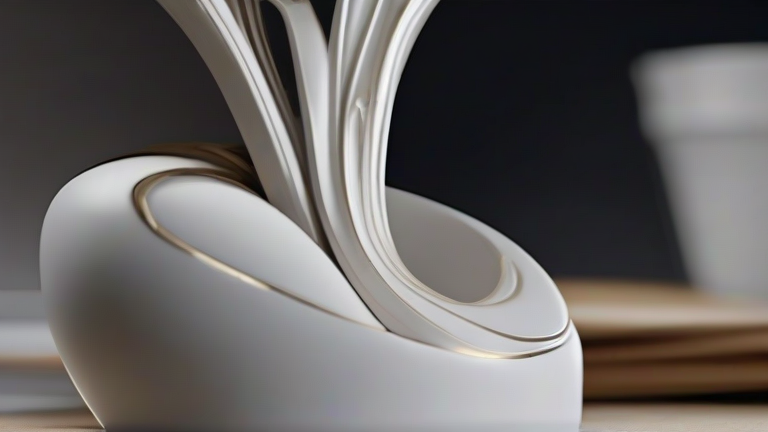
TL;DR: Digital tools—from AI-driven generative design to robotic 3D-printing of clay—now let artists create porcelain sculptures with undercuts and latticework impossible by hand. These technologies cut production time by up to 60% while enabling mass-customization of figurines, without sacrificing the material’s translucent, high-fire finish.
From Kiln to Code: The New Workflow
Traditional porcelain sculpting is unforgiving: shrinkage (10–15%) and cracking during firing demand years of tactile mastery. Today, artists scan clay maquettes with structured-light 3D scanners (resolution: 0.05 mm) to build digital twins. Then, generative adversarial networks (GANs) suggest glaze patterns or anatomical variations—e.g., a dancer’s flowing robe with zero internal stress points. The breakthrough is slip-casting 3D printers like the WASP Clay 4.0, which extrude a 0.3 mm layer of high-kaolin slip. These machines deposit clay with 0.1 mm positional accuracy, enabling hollow, self-supporting structures (like a 40 cm tall phoenix with individual feathers that would collapse under hand-building).
If you want to dig deeper, check out our guide on Invest in Porcelain Figurines: Top Business Strategies.
Specs Driving the Renaissance
Key specs: print bed volumes up to 1000×1000×1200 mm, nozzle diameters from 0.6 to 2.0 mm, and software that simulates shrinkage based on clay moisture content (e.g., ClaySim predicts final fired dimensions within ±0.3%). Robotic arms with 6-axis motion now carve reliefs on curved surfaces—a process called “subtractive digital ceramics”—using diamond-coated burrs at 20,000 RPM. Post-processing uses AI-controlled drying chambers that maintain 60% humidity, reducing crack rates from 30% to under 4%.
Industry Impact and Market Shift
For manufacturers of collectible figurines (e.g., Meissen-style court ladies or anime-inspired statuettes), digital workflows enable on-demand micro-batches. Instead of casting 500 identical pieces, a brand can offer 50 personalized variants—changing a flower’s tilt or a kimono’s pattern—at only 15% cost increase. Auction houses now certify “hybrid provenance” (human-sculpted base + AI-optimized wings), adding value. However, purists argue that digital tools flatten the subtle irregularity of hand-thrown marks. To counter this, software like ArtifactNoise artificially reintroduces tremors and fingerprint ridges into G-code paths.
FAQ
Q: Will 3D-printed porcelain crack in the kiln like hand-made pieces?
A: No—digital slip-casting uses uniform wall thickness (controlled by slicing software) and optimized drying, so shrinkage is predictable. Fired strength matches or exceeds hand-crafted porcelain (flexural strength ~65 MPa).
Q: Can traditional sculptors learn these tools without coding skills?
A: Yes. Modern interfaces like CeramicaCAD use touch-sensitive haptic pens that mimic clay modeling. AI automates supports and hollowing, while tutorials convert hand gestures into print paths—most artists master basics in 20 hours.
Q: Are these digital porcelain sculptures considered “authentic” art?
A: The market says yes: major museums (e.g., V&A) now acquire hybrid works. Authenticity shifts from “human-only touch” to “human-guided algorithmic intent,” similar to photography’s acceptance in the 19th century.
Leave a Reply