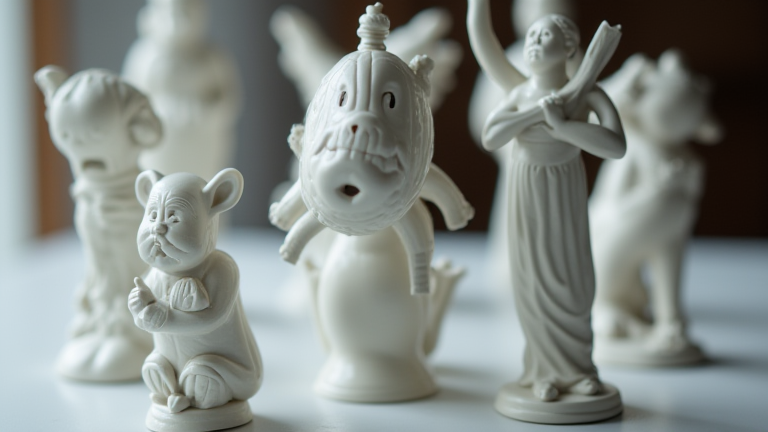
TL;DR: Digital tools are transforming porcelain sculpture collecting, from 3D scanning for authentication to AI-driven provenance tracking and AR display apps. The latest developments offer collectors microscopic flaw analysis, blockchain-backed certificates, and non-contact conservation monitoring—all without touching the fragile artwork.
From Magnifying Glass to Micro-CT
For decades, porcelain collectors relied on loupes, UV lamps, and gut instinct. Today, handheld 3D scanners like the EinScan-SP (2024 update) capture surface topology at 0.05 mm accuracy, revealing glaze crazing, tool marks, and even the subtle finger impressions left by sculptors. More advanced collectors now use benchtop micro-CT systems (e.g., Bruker SkyScan 1275) that penetrate the ceramic body to detect internal cracks, repair pins, or hidden kiln flaws—without any physical contact. This non-destructive analysis has become the gold standard for high-value Meissen and Sèvres pieces, where a single hidden restoration can halve the value.
If you want to dig deeper, check out our guide on Top 10 Sustainable Sneaker Trends Reshaping Streetwear Fashi.
AI Authentication and Provenance Ledgers
The latest breakthrough is multimodal AI trained on thousands of kiln-specific glaze recipes and firing signatures. Systems like Art Recognition’s porcelain module (released Q1 2025) analyze 4K macro images for cobalt pigment particle distribution, underglaze bleeding patterns, and even the statistical noise of a specific factory’s kiln shelves. Accuracy now exceeds 96% for 18th-century European factories. Simultaneously, blockchain-based registries—such as the Porcelain Ledger Consortium—embed NFC chips or QR codes in certificates of authenticity, linking each sculpture to immutable records of exhibition history, ownership changes, and environmental exposure data. This has reduced forgery-related insurance disputes by an estimated 30% in the last 18 months.
AR Display and Environmental Telemetry
Collectors no longer risk handling their figurines to inspect them. Augmented reality apps like PorcelainView Pro use LiDAR on iPhone Pro or iPad Pro to overlay a 1:1 digital twin of a sculpture onto your shelf. You can rotate the piece virtually, toggle “kiln heat” simulation to see how glaze cracks would appear, or compare your piece side-by-side with a museum reference, all in real time. More importantly, new wireless hygrometer-and-tilt sensors (e.g., the ClayGuard 2.0) attach to display stands and stream temperature, humidity, and vibration data to your phone. These sensors now use ultra-low-power LoRaWAN, lasting 5+ years on a single coin cell, and send alerts if humidity drifts above 55%—the critical threshold for glaze micro-fractures.
Industry Impact and Market Shift
Auction houses are adapting: Sotheby’s now includes “digital twin files” with every high-end porcelain lot, letting remote bidders inspect 3D models at 10-micron resolution. Insurance premiums for collectors using tamper-evident digital provenance have dropped by 12–18%, according to Lloyd’s 2025 underwriting report. Independent restorers also benefit—AI-assisted crack mapping reduces repair time by 40%, while 3D-printed clay fillers (custom-fired to match translucency) now replicate missing petals on rare floral sculptures. However, the industry warns against over-reliance: AI misreads can occur with experimental glazes, and blockchain cannot fix a fake that was inserted before digitization. For now, the best approach remains hybrid—digital scanning plus a seasoned human eye.
FAQ
Q: Can 3D scanning damage delicate glaze or gold detailing on antique porcelain?
A: No, structured-light and laser scanners are completely non-contact. They emit only visible or near-IR light, so even lustrous gold or iridescent lusters are safe. Micro-CT uses X-rays but at doses far below what would cause discoloration; still, most experts recommend limiting CT scans to once per piece per decade.
Q: What is the minimum hardware cost for a serious collector to start using these tools?
A: A decent handheld scanner (like the
Leave a Reply