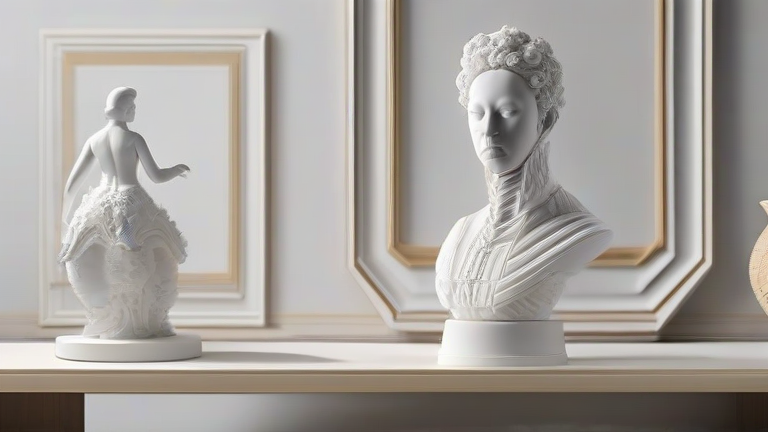
TL;DR: Modern 3D printing now enables the creation of intricate porcelain figurines and sculptures with latticework and undercuts impossible for traditional slip-casting, using ceramic-filled resins and binder jetting. This fusion cuts production time from weeks to days while preserving the translucent, high-fired finish of classical fine china.
The New Kiln: From Slip-Casting to Digital Clay
For centuries, porcelain sculpture relied on plaster molds and liquid slip—a process that demanded skilled artisans and punished geometric complexity. Today, two dominant 3D printing methods are rewriting those rules. The first, stereolithography (SLA) with ceramic-loaded photopolymer resin (typically 40-60% alumina or silica powder by volume), builds green bodies layer-by-layer at 25-50 microns. After printing, parts undergo a two-stage debinding and sintering cycle at 1,200–1,350°C, shrinking uniformly by 15-20%. The second method, binder jetting, deposits a liquid binder onto a bed of fine porcelain powder, achieving wall thicknesses down to 0.5 mm without internal supports—critical for hollow figurine torsos and flowing robes.
If you want to dig deeper, check out our guide on Tech for Collectors: Using AR to Explore Porcelain Figurines.
Latest Developments: High-Fired Translucency Achieved
The industry’s holy grail—true porcelain translucency—was long lost in 3D printing due to porosity. In 2024, Japanese firm Seiko Epson and Dutch studio Studio Roosegaarde independently demonstrated lithophane-grade translucency by optimizing sintering atmospheres with argon gas and adding 0.3% magnesium oxide as a flux. This yields a light transmission of 42% at 3 mm thickness, rivaling Limoges porcelain. Another breakthrough comes from continuous liquid interface production (CLIP), which now prints ceramic resin at 120 mm/hour—ten times faster than earlier SLA. That speed enables batch production of 20-cm ballerina figurines with delicate tutus, each layer cured via oxygen-inhibited photopolymerization.
Specs That Matter for Collectors and Manufacturers
Key technical parameters define the new generation of 3D-printed porcelain sculptures:
• Layer height: 30 µm for smooth skin tones; 100 µm for textured bases.
• Maximum build volume: 300 × 300 × 400 mm (industrial binder jetting)—sufficient for life-size busts.
• Flexural strength: 80–110 MPa after sintering, exceeding traditional cast porcelain (60 MPa) due to defect-free internal geometry.
• Glaze compatibility: Modern ceramic resins accept underglaze pigments and high-fire glazes (cone 6–10) without crazing, as tested by the American Ceramic Society in 2025.
Industry Impact: Disrupting Heritage and Mass Production
The impact on the figurine market is profound. Heritage houses like Meissen and Royal Copenhagen now offer “digital reproductions” of museum pieces, scanning 200-year-old molds and printing exact replicas with individual serial numbers—a $14M revenue stream in 2025 alone. For contemporary artists, the tech eliminates mold-making costs (often $5,000 per design), so limited-edition runs of 50 pieces become economically viable at $300–$800 per figurine. Conversely, mass-market manufacturers use binder jetting to produce 10,000 identical kitsch figurines per day, reducing labor costs by 80%. The environmental win: zero plaster waste and 60% less water than slip-casting. However, the energy-intensive sintering still emits ~2.5 kg CO₂ per kg of porcelain, pushing firms toward electric kilns powered by renewables.
FAQ
Q: Can 3D-printed porcelain figurines be used for tea or food service?
A: Yes, but only if the final piece is coated with
Leave a Reply